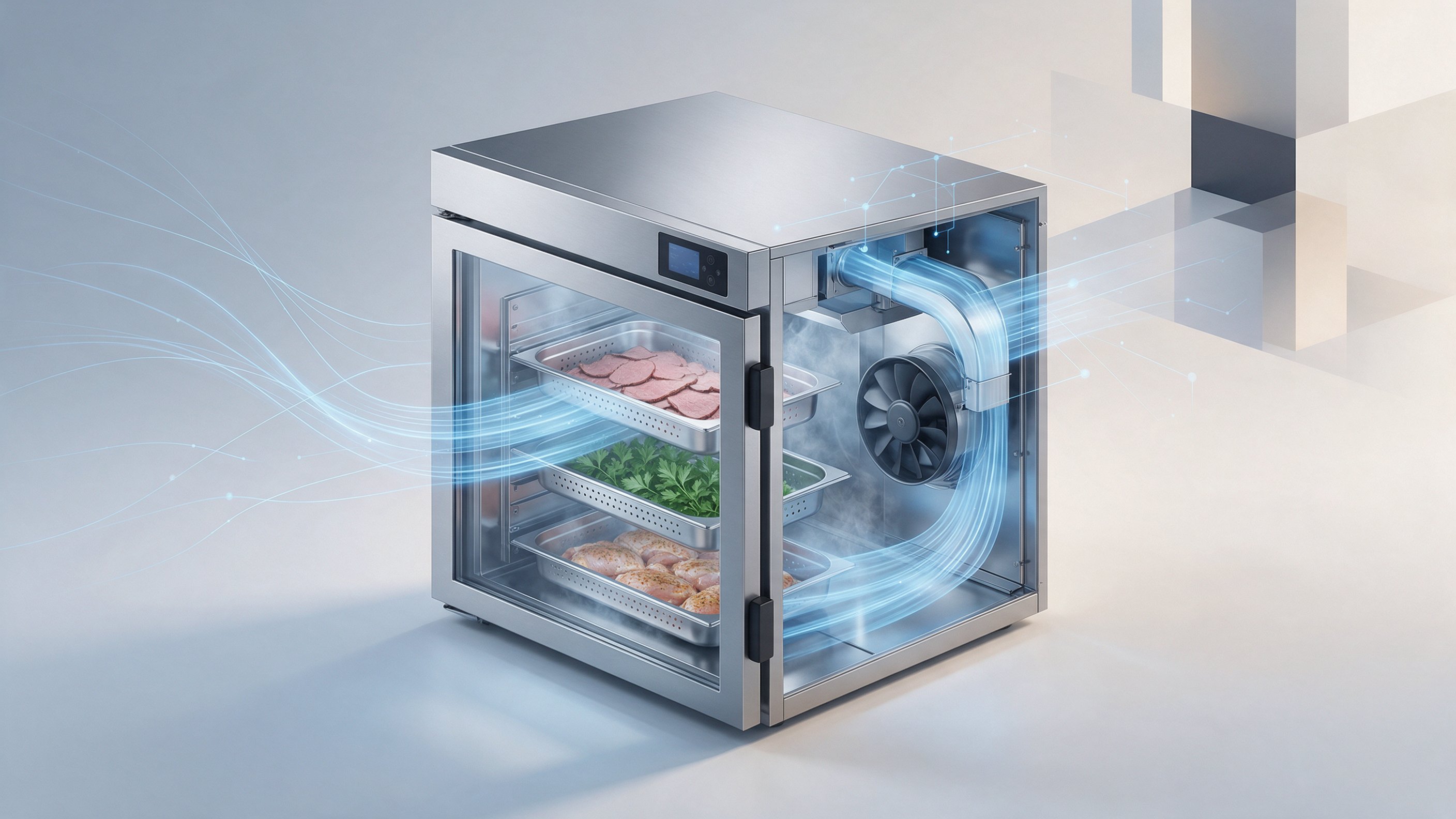
Commercial refrigeration is being reshaped by food safety, energy costs and European regulation. Blast chillers, once a specialised element of professional kitchens, are now positioned as a key solution for optimising processes, improving food quality and moving toward more efficient, sustainable installations. The change is not simply a matter of adding cooling capacity. It reflects a broader shift in how refrigeration systems are designed, controlled and assessed.
Rapid cooling is the core function. Blast chillers use intensive cold-air circulation to bring food from more than 70°C to below 3°C in as little as 90 minutes. That speed matters because the range between roughly 63°C and 4°C is a danger zone in which microorganisms can multiply quickly. Reducing time in that range is a fundamental HACCP principle, and the equipment is designed to support it. The stated benefits go beyond compliance: limited bacterial growth, longer shelf life, better retention of texture, moisture, aroma and nutritional value, and improved planning and waste reduction in high-volume kitchens, hospitals, hotels, catering and food processing.
Airflow is the hidden performance variable
Performance depends heavily on how cold air reaches the load. Heat transfer is effective only when airflow is uniform across the entire batch. Areas of low air velocity or turbulence can leave parts of the product cooling more slowly or improperly. Those temperature differences can compromise food safety, extend cooling times and reduce final quality. This makes the fan a strategic component rather than an accessory. EC motors combine high electrical efficiency with continuous speed control, allowing airflow to be matched to each stage of the cooling process. When combined with biomimetic impeller design and next-generation composite materials, the result is described as more uniform cold-air distribution and lower energy consumption.
The article also links EC fan technology to operational gains: improved turbulence control can reduce noise and improve working conditions; lower heat generation can support refrigeration system performance; and lower mechanical stress with precise control can extend service life and reduce maintenance. Energy use is tied directly to installation profitability, especially as electricity costs rise. Still, the claim is system-level. Electronics can optimise operation, but aerodynamic performance ultimately determines cooling uniformity and results.
Digital management adds traceability
Modern blast chillers can select programs according to food type, monitor temperature through probes and record the full process for traceability. That record is valuable in food safety audits and helps demonstrate HACCP compliance. Open communication protocols such as Modbus allow units to be integrated into kitchen infrastructure and building management systems, supporting remote monitoring and predictive maintenance. Continuous analysis of temperatures, fan speeds, operating hours and energy consumption can reveal deviations before they become failures, reducing maintenance costs and improving availability.
Regulation pushes beyond energy performance
European regulation is pushing design criteria beyond energy performance alone. The Ecodesign framework is evolving to include durability, repairability, digitalisation and efficiency at both component and system level. The Ecodesign for Sustainable Products Regulation is described as a turning point, and the 2026 horizon is already influencing decisions by manufacturers and engineering firms, even though many measures will be introduced progressively. The practical consequence is that improvements will no longer depend solely on the refrigeration circuit. Motors, fans, heat exchangers and electronic systems become equally critical to reaching the efficiency levels the market demands.
System design and industry roles
That changes the design logic. Increasing cooling capacity was once the primary objective; the focus now is on maximising energy performance by optimising every component in the system. It also explains closer collaboration between equipment manufacturers and specialists in ventilation, electronic motors and control systems. ZIEHL-ABEGG is cited as an example, with EC axial fans for commercial refrigeration and food service that combine high-efficiency motors, optimised aerodynamic design, low noise and communication through open protocols for integration into intelligent energy management. The example illustrates the wider point: overall blast chiller efficiency depends on the combined performance of all components, and optimal laminar distribution of cold air is presented as a way to deliver faster, better cooling while reducing the equipment’s carbon footprint over its service life.
The shift also redefines industry roles. Manufacturers are expected to keep investing in innovation to meet more demanding regulatory requirements. Installers will need broader expertise in electronics, connectivity and control systems, because customers are seeking not only refrigeration capacity but solutions that reduce operating costs and ensure reliability. The integration of intelligent components, remote monitoring and predictive maintenance can turn installation professionals into technology advisors who add value across the equipment lifecycle.
The case for blast chillers is therefore stronger at the system level than at the level of a single component. Food safety remains the primary objective, but the article frames it alongside energy efficiency, digitalisation and sustainability as parts of one concept. The next generation of commercial refrigeration equipment must not only produce cold effectively; it must do so with minimum energy consumption, greater connectivity and flexibility for emerging regulatory and environmental challenges. The case is presented as a design argument rather than a measured installation result: savings and cooling outcomes will still depend on load, airflow uniformity, control settings and maintenance.